

Selling the Meter While Giving Away the Recipe
American labs sell a subscription, a speed tier, an ad slot, a plug-in store, and a meter—the whole kitchen sink. DeepSeek just sells the meter. Its models are MIT licensed, so anyone can download them, run them, and even sell them against DeepSeek if they want.
One reply raised the obvious question: if inference is the revenue strategy, why open source the inference so everyone can use it for free? The response was that the revenue strategy is to be awesome. When everybody has the recipe, the only way to win is to run the best and cheapest kitchen in town.
The spending numbers highlight the difference. One lab expects to spend 665 billion dollars training and running its models through 2030. DeepSeek spent about 1.6 billion on AI infrastructure in the first seven months of this year. To be fair, DeepSeek still lost about 106 million over those seven months. One of these plans fits on a napkin.
Open Sourcing the Entire Stack
DeepSeek is effectively open sourcing the whole company at this point. It is sharing its product stack to help the community lower compute costs, reduce energy use, and make AI more affordable. The CEO is very loaded. This has caused a stir.
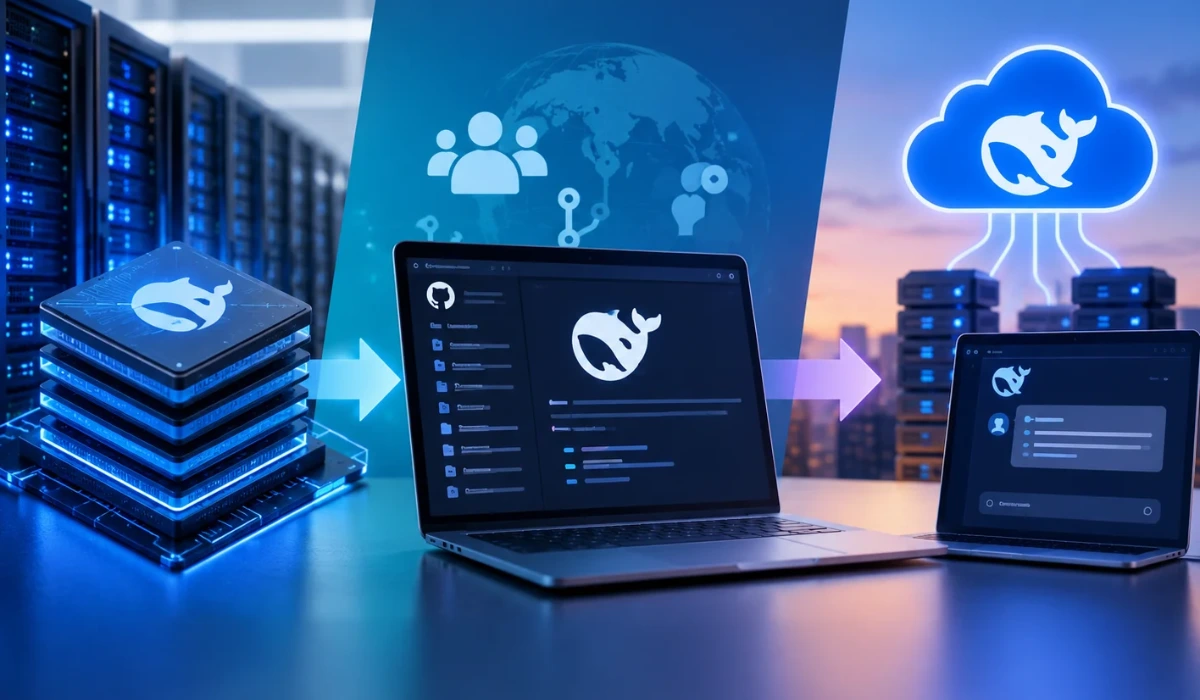
DeepSeek released DeepInfer, its in-house inference framework, now fully open source. It powers DeepSeek V4.1 Flash at scale with high throughput and low latency. The company is sharing its production stack so the community can lower compute costs, reduce energy use, and make AI more affordable. This is the long game.
DeepSeek is the biggest threat to the US frontier labs. A DHS order should come as no surprise. The US government bans DeepSeek, claiming it is because the servers are in China. It bans even US inference providers if they are using DeepSeek, and it bans anything built with or based on DeepSeek models. Someone higher up was convinced that the models themselves are calling home. Anyone running a decent firewall would see that if it happened. Many open-weight models have been run without anything calling home, and it would be visible if it did.
People think DeepSeek just makes cheap models distilled from Claude and ChatGPT. They are missing that DeepSeek is playing an entirely different game. The founder is the wealthiest frontier lab founder if you do not count certain others. He is wealthier than Dario Amodei and Sam Altman and has majority control. The company can play a much longer game than the other labs.
Look at the choices. It releases model weights under an MIT license. Others, such as Kimi and GLM, keep commercial conditions on theirs. DeepSeek is willing to let anyone run the model and compete with its own API. It publishes unusually detailed research. Its original DeepSeek R1 research helped every lab, including the Western ones—OpenAI, Anthropic, and others. It ruthlessly focuses on low inference costs. The company is clearly compute constrained, and its architecture choices are optimized for cost. It is forced to be efficient because it does not have the ability to throw unlimited amounts of compute at the problem the way OpenAI and Anthropic do. That forces actual efficiency.
American labs are wasteful. They are burning so fast because the VCs keep feeding them money. A founder who can afford to wait, take decades, who has already built a true challenger, and who is willing to put the model and research out in the open has a different position. The biggest constraint has been the chips. Huawei’s 950 DT is coming. When DeepSeek gets the chip, it is going to kick everybody’s butt.
The Ban and the Alternative
If America is worried about China winning, the answer is not a banned list. It is better American open-weight models. Banning it does not make better models. DeepSeek keeps shipping open-weight models. Anyone can download, run, and build on them. That is why it is everywhere. Ship the weights, or lean into the tools they are giving, see what they are doing, learn from it, and keep iterating. Banning is a stick-your-head-in-the-sand tactic, and the DHS approach is silly.
DeepInfer is the inference tool and engine released so people can run and build out their own inference. The company has given the tools: the original DeepSeek V3, the original DeepSeek R1, and now the DeepSeek Harness to run these models. It is not just giving the models. It is giving away free harnesses and the whole stack.
Sam Altman is watching DeepSeek slowly open source the entire AI stack. Today it open sourced DeepInfer, the framework used to run V4.1 Flash at scale. It includes optimized inference kernels, distributed inference, speculative decoding, async scheduling, structured outputs, and NVIDIA plus Ascend support. It is all Apache 2. DeepSeek has already released model weights, research, training recipes, its coding harness, and now the inference framework running V4.1 Flash. Every few months another layer of DeepSeek becomes public. At this rate, it is going to open source the whole stack piece by piece.
Chip Partnership and the Long Game
DeepSeek and Huawei are teaming up on a new AI chip designed to challenge NVIDIA. DeepSeek would be working with China’s biggest chip maker to reduce reliance on US chips. This comes a week after China’s CXMP chip progress sparked a global sell-off in stocks. If they can build out this chip and start to mass-produce it with what DeepSeek produces and what it has given away, they are going to become a very big challenger to the Western US frontiers.
It is official: DeepSeek is the actual OpenAI now. The simple plan is going to win the long game.

A Similar Open Approach
The same principles of playing the long game appear elsewhere. Open sourcing a harness shows how to build on AI by putting the work out in the open. The approach is local first, always—never pump customer data into the cloud. Customer data is the number one asset and should not be given away. Unlimited tokens change the game: stop and think about what you can run with AI if you let it run forever. Sandbox by default, and fully open source.
Installation of such a system is straightforward. On the inference side, run a curl script, select the option, and let it auto-detect hardware and dependencies. Then run the tunnel setup to create a secure tunnel, verify with email OTP, copy the relay config commands, and the GPU inference powerhouse is ready. This architecture keeps heavy local GPU inference completely separate from the coding agent via a secure relay. On the client side, open VS Code, search for the extension, install it, connect the relay, and the local setup is accessible from anywhere.
Most companies do not have a technology problem. They have a leadership problem, and they are paying for it in missed deadlines, failed integrations, and AI investments that delivered nothing. The businesses winning right now are not the ones chasing the latest AI trends. They are the ones who built on solid engineering and treated AI as infrastructure. They own control and integrate the software that actually works.
Custom software development covers database architecture, API design, system integration, and scalable infrastructure built the right way. When AI belongs in a solution, it is designed into the architecture, running in the customer’s environment—not a vendor’s cloud and not on someone else’s pricing schedule. An open-source platform that is a terminal-native AI coding agent running entirely on a local LLM delivers zero API costs, zero telemetry, and full ownership. As a fractional CTO, the same standard of leadership is available without the full-time executive costs: strategic architecture, hands-on delivery, and clear accountability.
DeepSeek’s approach of building, open sourcing, and selling the meter while focusing on efficiency and the long game continues to play out as more of the stack becomes public.
Conclusion
DeepSeek’s one-sentence strategy—build the models, open-source the models and the stack, and sell the inference—has produced an 82% gross margin, a $1 billion run rate, and progressive release of its full infrastructure while staying compute-efficient. The same simple plan is still unfolding as more of the stack becomes public and chip partnerships advance.

