The Productivity Crisis Nobody Talks About
Startup productivity rarely collapses overnight. It erodes quietly as developers lose valuable minutes to IDE freezes, builds fail without clear reasons, and onboarding stretches into weeks instead of days. Each problem feels minor on its own, but together they become catastrophic. Legacy development stacks were designed for large enterprises that rely on stable teams, long timelines, and heavy processes, while startups operate under completely opposite conditions with small teams, constant pivots, and extreme time pressure. When tooling fails in this environment, it does more than frustrate developers. It delays learning, blocks experimentation, and increases burn rate. This is why many founders turn to a fractional CTO, not for writing code but for gaining clarity. An experienced fractional CTO often identifies tooling and workflow as the real bottleneck. Microsoft appears to have listened.
Microsoft’s Unexpected Move
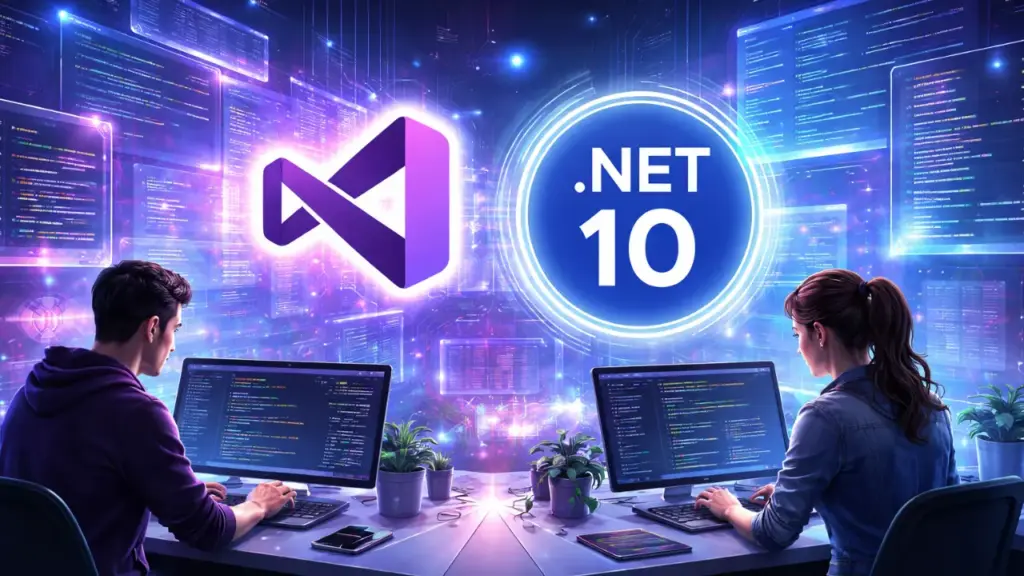
For years, developers mocked Microsoft tools as heavy, slow, and bloated. Visual Studio 2026 breaks that reputation in a meaningful way. This release is not about competing with trendy editors or chasing hype. It focuses on fixing foundational problems that startups quietly accepted as “just part of development.” .NET 10 continues this shift by prioritizing stability, simplicity, and long-term support. These qualities may not sound exciting, but they are exactly what startups need to survive and scale. Microsoft did something rare with this release. It optimized for real-world productivity instead of polished marketing demos.
Feature #1–3: Stability Over Flash
1. 50% Reduction in IDE Freezes
IDE freezes destroy focus, and focus is everything in a startup environment. When developers lose concentration, productivity drops immediately. Visual Studio 2026 cuts IDE freeze incidents by nearly half, and this improvement is not cosmetic. It directly increases usable development hours by reducing interruptions. With less waiting and fewer disruptions, teams spend more time building, shipping, and moving the product forward.
2. Predictable Performance Under Load
Large solutions no longer feel fragile, and refactoring no longer feels like a risky move. The IDE behaves consistently even as projects grow in size and complexity. This reliability becomes critical when a startup transitions from an MVP to a scalable product, where stability directly affects speed, confidence, and long-term growth.
3. Fewer Random Failures
Unexplained crashes slowly erode developer trust and disrupt focus. Instead of building features or solving real problems, developers waste valuable time diagnosing tool-related issues. This release removes that friction and allows teams to stay productive and focused on what truly matters.
Feature #4–6: File-Based Apps Change Everything
4. No Project Files Required
This is a quiet revolution in the way applications are built and tested. Developers can now run apps directly from files without dealing with complex project setups or fragile configurations that often slow progress. This approach removes unnecessary friction and makes development faster and more flexible. It is especially powerful for prototypes and MVPs, where speed, simplicity, and rapid iteration matter more than rigid structure.
5. Faster Experimentation
Ideas move from concept to execution much faster when teams remove unnecessary setup and friction. Developers can test assumptions quickly without waiting on complex configurations or fragile project files. Startups win by learning faster than their competitors, and file-based apps enable this continuous learning loop by making experimentation simple, fast, and repeatable.
6. Easier Collaboration
New developers can start contributing immediately without the need for long setup guides or worrying about complex environment issues. This is especially valuable for remote teams, where consistent and easy onboarding can significantly improve productivity.
Feature #7–9: Long-Term Support That Actually Helps Startups
7. Three Years of Guaranteed LTS Support
.NET 10 offers long-term stability, allowing founders to plan confidently without the fear of forced upgrades, which in turn reduces technical debt anxiety.
8. Fewer Emergency Upgrades
Unexpected framework changes can destroy a team’s momentum, forcing developers to spend time troubleshooting and adapting instead of building. With long-term support (LTS), such disruptions are minimized, allowing teams to stay focused on product development rather than constant maintenance.
9. Better Security Without Constant Churn
Security updates now arrive without causing breaking changes, which protects startups while keeping their development processes smooth and uninterrupted.
Feature #10–12: Shipping Faster with Smaller Teams
10. Simplified Tooling
Visual Studio 2026 removes unnecessary complexity, allowing developers to spend less time navigating tools. This streamlined environment increases clarity, which directly improves overall output.
11. Lower Cognitive Load
Fewer mental context switches lead to better decision-making, allowing developers to focus more deeply and write cleaner, more efficient code. Over time, this focus compounds, resulting in significantly higher productivity and improved overall software quality.
12. Real Cost Reduction
Speed reduces burn, and burn ultimately determines survival. A smaller team that ships faster consistently outperforms a larger team that moves slowly.
Why Smart Founders Are Switching Early
Early adopters gain structural advantages because they ship faster, iterate more, and reach product-market fit sooner. Waiting may feel safe, but it is not. Every month spent on a slower stack is a lost opportunity, while switching early creates compounding gains that competitors struggle to catch. This is why many fractional CTOs now recommend reevaluating the entire Microsoft stack—not out of loyalty, but out of pragmatism.
The Real Competitive Advantage Isn’t Talent
Founders love hiring great developers, and there is no doubt that skilled engineers matter. However, the tools they use shape their output even more than their individual talent. Even elite developers struggle when working in broken or inefficient environments, where bad tooling can turn potential into wasted effort. On the other hand, great tools amplify a developer’s ability, enabling them to perform at their best. Visual Studio 2026 and .NET 10 remove the obstacles that developers should never have had to face in the first place, allowing teams to focus on building and innovating rather than fighting their development environment.

FAQS
Is Visual Studio 2026 good for startups?
Yes. It reduces freezes, speeds onboarding, and supports rapid iteration.
Does .NET 10 work for MVPs?
Yes. File-based apps make prototyping faster and simpler.
Should early-stage startups use LTS frameworks?
Yes. Stability reduces maintenance cost and risk.
Is Microsoft tooling still bloated?
Less than before. This release focuses on performance and simplicity.
Conclusion: The End of Bloated Startup Stacks
Startup failure often appears strategic, but more often, it is operational. Slow tools delay learning, and delayed learning can ultimately kill startups. Visual Studio 2026 with .NET 10 is not just hype—it is a correction. Microsoft has removed the friction that startups have quietly endured for decades. Founders who treat tooling as a strategic decision will move faster, while others may burn significant capital learning the same lesson too late. At StartupHakk, we focus on decisions that quietly separate winners from losers, and this stack change is a prime example.