
The Scale of OpenAI’s Spending Problem
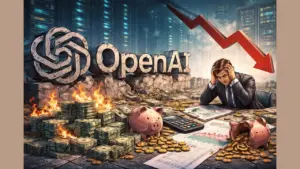
AI does not run on hope. It runs on compute. Every model training cycle costs millions, and every improvement demands more GPUs. Each new feature increases inference load and pushes infrastructure limits further. Unlike traditional software, where costs often flatten as scale increases, AI systems become more expensive over time. As usage grows, compute requirements rise, and costs grow instead of shrinking.
OpenAI pays for:
- Massive GPU clusters
- Continuous retraining
- Real-time inference
- Redundancy and uptime guarantees
- Global deployment
This is not a one-time investment. It is a permanent burn. Even small usage spikes create enormous bills, and there is no concept of “free growth” in this model. Every increase in demand directly increases cost, which makes scalability far more dangerous than it appears. That is the first red flag.
Why “Just Raise Prices” Won’t Fix It
Many assume pricing solves everything, but it does not. Most users expect AI to be cheap, and some even expect it to be free. This expectation is already baked into the market and shapes how people evaluate and adopt AI products.
If OpenAI raises prices too fast:
- Developers switch providers
- Startups migrate to open models
- Enterprises renegotiate or exit
Competition makes this problem even worse. Every major cloud vendor is building its own AI alternatives, while open-source models improve at a rapid monthly pace. At the same time, smaller players aggressively undercut pricing to win market share. OpenAI cannot afford to price itself out of relevance in this environment, and as a result, its margins remain thin—very thin.
The Hidden Trap: AI Is Not SaaS
This is where most analysts get it wrong. AI does not behave like SaaS. Traditional SaaS products benefit from scale because infrastructure costs flatten as user numbers grow, which leads to expanding margins over time. AI works in the opposite way. Every new user interaction increases compute demand, drives up inference costs, and adds ongoing operational expense. Growth does not automatically improve profitability. In many cases, it increases losses instead.
In SaaS:
- More users = more profit
- Infrastructure costs stabilize
- Margins expand
In AI:
- More users = more compute
- More compute = more cost
- Margins compress
Every prompt costs money, and every response burns GPU cycles. There is no magic efficiency curve in AI economics—there is only physics. This is why even record revenue numbers do not guarantee sustainability. In fact, rapid growth can increase losses instead of reducing them. That reality represents the second major red flag.
What WSJ and Financial Analysts Are Flagging
Recent Wall Street Journal reporting highlights this issue clearly. While OpenAI’s revenue is growing at an impressive pace, its losses are expanding even faster. Analysts on X, including detailed breakdowns such as FinanceLancelot’s threads, point to the same core problem: OpenAI’s cost base scales linearly with usage rather than logarithmically like traditional software. This dynamic alarms investors. Capital markets are willing to tolerate losses during a defined growth phase, but they do not support business models built on permanent losses. Eventually, the tone of funding shifts, patience fades, and that turning point may arrive much sooner than many expect.
Lessons From Past Tech Giants That Looked Unstoppable
History is full of bold tech dreams, yet most of them failed.
We have seen:
- Telecom companies crushed by infrastructure debt
- Cloud startups destroyed by pricing wars
- Hardware innovators buried by operating costs
The pattern repeats. Big vision attracts big money, and big money often hides underlying economic weaknesses. Eventually, these bad economics surface. OpenAI’s ambition is historic, and so is its burn rate. This combination has ended many empires in the past. While it does not guarantee failure, it certainly demands caution.
The Competitive Pressure OpenAI Cannot Escape
OpenAI does not operate alone. Cloud providers are building their own in-house models, open-source communities are moving quickly, and governments are investing in sovereign AI solutions. As a result, differentiation in the market is shrinking every day. When performance gaps narrow, price becomes the deciding factor—and pricing is OpenAI’s weakest point. Lower-cost models are likely to capture large portions of the market, especially at scale. Once customers leave, they rarely return, making this a significant red flag for OpenAI’s long-term competitiveness.
What Happens If OpenAI Never Turns a Profit?
This is the hardest question.
If profitability never arrives:
- Investors absorb losses or exit
- Partnerships shift
- Developers face platform risk
Startups built entirely on OpenAI APIs become vulnerable, as pricing changes can destroy business models overnight. This risk is why experienced founders increasingly seek guidance from a fractional CTO—not for writing code, but for advice on risk strategy, platform dependency decisions, and long-term architecture planning. What feels like AI convenience today can quickly turn into technical debt tomorrow.
Is This the Beginning of the AI Reality Check?
AI is not dying, but the hype is clearly cooling. Markets are asking better questions: Where is the profit? Where is the efficiency? Where is the defensible moat? These questions matter because they separate sustainable AI from short-lived excitement. AI that creates real value will survive, while AI that burns capital endlessly will not. This shift is healthy—painful, but necessary for the long-term evolution of the industry.

Conclusion: Big Vision Alone Has Never Paid the Bills
OpenAI changed the world, and that part is undeniable. But changing the world does not guarantee profit. Costs compound, competition accelerates, and economics always win. Whether OpenAI adapts or not remains to be seen, but what is clear is this: blind belief is not strategy. Founders, developers, and investors must think clearly, plan defensively, and learn from history. That is the kind of grounded thinking platforms like StartupHakk exist to encourage. The AI future will be built by those who understand both innovation and reality, and reality is never optional.