The Illusion of AI Progress: Why the Public Got Distracted
For the past year, the AI world has been consumed by demos, launches, and hype cycles. People argued about which chatbot sounded more human or which multimodal model could generate prettier images. But that conversation missed the real story.
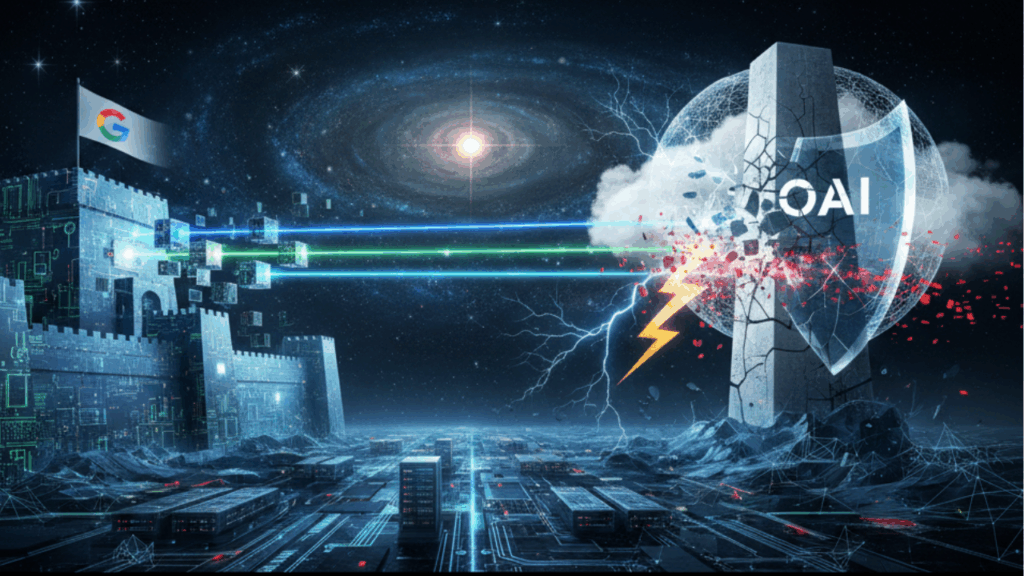
AI progress is not defined by flashy demos. It’s defined by infrastructure, cost curves, execution speed, and compute physics. Google understands this. While the world celebrated OpenAI’s announcements, Google engineers quietly executed at a scale most people still don’t understand.
The public saw the surface. Google built the foundation.
This contrast created an illusion. It made people believe OpenAI was ahead because they moved fast in public. But Google moved even faster behind the scenes. Their progress wasn’t loud. It wasn’t hyped. It wasn’t designed for viral social media. It was deep engineering work that compounds over time.
That illusion is now breaking. The memo signals the first crack.
Google’s Silent War Machine: Faster, Bigger, Cheaper AI
Google is not competing in the traditional tech sense. They are playing a different game. A game defined by infrastructure that is almost impossible for competitors to replicate.
Here’s what makes Google dangerous:
1. Their Compute Scale Is Unmatched
Google owns the largest AI training and inference infrastructure in the world. They built it for search, maps, YouTube, ads, and global data distribution. AI is simply plugging into an engine that already existed.
2. Their TPU Architecture Is Years Ahead
Google’s custom chips are optimized for training and inference at a scale OpenAI cannot touch. TPU v5 and v6 deliver cost-to-performance metrics that make GPUs look slow and expensive.
3. They Control the World’s Information Pipeline
Google Search, YouTube, Gmail, Android, and Maps give them real-time data flows that no other company can replicate. This data enables model accuracy that others can only dream about.
4. Their Internal R&D Moves at Physics Speed
Google DeepMind has been producing groundbreaking research for nearly 15 years. They were the first to demonstrate superhuman reinforcement learning. They invented transformers. They built the foundations the entire AI industry now depends on.
While OpenAI focused on consumer hype, Google quietly built a machine that optimizes every layer of AI. Hardware. Software. Data. Infrastructure. Distribution.
The result? A physics-level advantage.
Google isn’t just building better models. They are bending the cost curves of AI itself.
The Math OpenAI Can’t Ignore (And Why It’s Terrifying)
Most people don’t understand why AI dominance depends on math. This is where Google’s advantage becomes existential for OpenAI.
Training Costs Are Exploding
Large-scale models now require billions of dollars in compute resources. OpenAI does not own the hardware. They rely on Microsoft. That dependency adds cost, delay, and friction.
Google trains models on its own chips in its own data centers with optimized pipelines built over two decades.
Inference Costs Define Survival
ChatGPT’s biggest problem isn’t performance. It’s cost. Serving billions of users requires cheap inference. Google’s TPUs process tokens at a lower cost than any GPU cluster. That difference compounds.
If Google can generate the same output at half the cost, they win before the race starts.
Energy Efficiency Matters
AI is becoming an energy-intensive battlefield. Google’s infrastructure is designed for global scale, efficiency, and sustainability. OpenAI uses rented hardware that consumes more energy and produces higher operational costs.
Latency and Throughput Decide Market Share
In consumer markets, milliseconds matter. Google owns the internet’s backbone. They control CDNs, fiber networks, and global data centers. Their distribution advantage makes their AI faster and more reliable.
Physics Doesn’t Lie
Speed. Cost. Efficiency. Throughput.
When you add these variables together, you get Google’s biggest advantage: mathematical inevitability.
This is why Sam Altman’s memo felt uneasy. He understands the math better than anyone. And right now, the math does not favor OpenAI.
Why Sam Altman Sounds Nervous (And What It Really Means)
Leaders usually stay calm during competitive pressure. They keep internal morale high, even when things look bad. That’s why the memo matters. Sam Altman broke the pattern.
He admitted Google was moving too fast. He mentioned “economic headwinds.” He warned his team that things were about to get harder. This kind of message is not sent unless the situation is serious.
The memo suggests three deeper issues:
1. OpenAI’s Burn Rate Is Unsustainable
Scaling AI requires billions. Their model depends heavily on investor confidence and Microsoft’s support. Any fear in the market can disrupt this flow.
2. Their Release Pace Slowed Down
ChatGPT dominated in 2023. But by 2024–2025, Google increased velocity. Gemini became more capable, cheaper to run, and deeply integrated into Google’s existing platforms.
3. Their Technical Debt Is Catching Up
Moving fast created internal complexity. Maintaining multiple models, versions, and modalities at scale slows down innovation.
In other words, the memo wasn’t about vibes. It was about survival.
The Empire Strikes Back: Google’s Strategic Reset
Google spent years quietly reorganizing their AI divisions. They merged teams. Unified research groups. Streamlined hardware and software development. The biggest shift came when DeepMind and Google Brain joined forces.
This reset created a single AI engine. One mission. One roadmap. One acceleration path.
Here’s what emerged from that unification:
- Gemini models with deep multimodal capability
- TPU v6 with massive performance gains
- Search-integrated AI that reaches billions instantly
- AI-powered YouTube, the world’s largest video platform
- Android-level distribution, touching 3+ billion devices
The empire didn’t strike back with announcements. They struck back with execution. Quiet, steady, relentless execution.
This is why OpenAI is nervous. Google doesn’t need to compete for attention. They simply deploy AI into products that billions already use.
That is true dominance.
What Happens to the AI Market If OpenAI Cracks
OpenAI will not disappear. But the power dynamics will shift if Google continues accelerating while reducing AI costs.
Here’s what could happen next:
1. Pricing Wars
Google could slash AI API prices. OpenAI cannot match that without losing massive revenue.
2. API Dominance
Developers follow speed and cost. If Google offers both, ecosystems shift.
3. Talent Migration
Top AI researchers follow infrastructure. Google offers the deepest research environment in the world.
4. Investor Confidence Shifts
Money flows to the company that controls the cost curves of the future.
5. Enterprise Market Changes
Large organizations want predictable cost, scalable compute, and long-term stability. Google’s model fits those requirements.
This shift will reshape the entire AI landscape. OpenAI will remain important, but it may lose the leadership position it once enjoyed.
Conclusion:
The leaked memo was not a mistake. It was a signal. A message that the AI race is entering a new phase. The companies with the strongest infrastructure, the fastest chips, and the deepest research talent will lead the next decade.
Google is executing quietly, fast, and with precision. OpenAI is fighting hard, but the math is not on their side. The physics of AI favors the company that owns the entire stack—from hardware to distribution.
If you want to understand the future of AI, don’t watch the demos. Watch the compute. Watch the data pipelines. Watch the cost curves. That’s where the real war is happening.
And as you analyze this shift, remember this truth: the empire has already struck back, and only a few people can see it clearly.
This analysis reflects the deeper trends shaping modern AI strategy—insights valuable for developers, founders, and even a fractional CTO building scalable tech operations. And for readers following technology insights on platforms like startuphakk, this story reveals how the next decade will be defined not by hype, but by infrastructure.