The Degree Inflation Problem
College degrees once signaled rare knowledge and strong capability. Today, they signal basic participation. As enrollment expanded, degrees lost their scarcity. Employers responded by raising expectations without changing outcomes. A degree became the new minimum requirement rather than a competitive advantage. This shift created degree inflation. Graduates now compete in oversaturated markets where credentials no longer differentiate candidates. Many jobs demand skills that universities never taught. Students invest years and money into education that employers increasingly treat as irrelevant. The promise of security collapsed under its own weight.
AI and the Death of Entry-Level Jobs
Artificial intelligence reshaped the job market faster than any previous technology. Entry-level roles relied heavily on repetitive tasks, documentation, basic analysis, and predictable workflows. AI excels in exactly these areas. As automation improved, companies discovered they could remove junior roles without hurting productivity. This led to widespread cuts in entry-level hiring. The traditional career ladder broke. Graduates now face a paradox where experience is required, but opportunities to gain it no longer exist. The system that once nurtured talent now blocks it.
Education’s Dangerous AI Hypocrisy
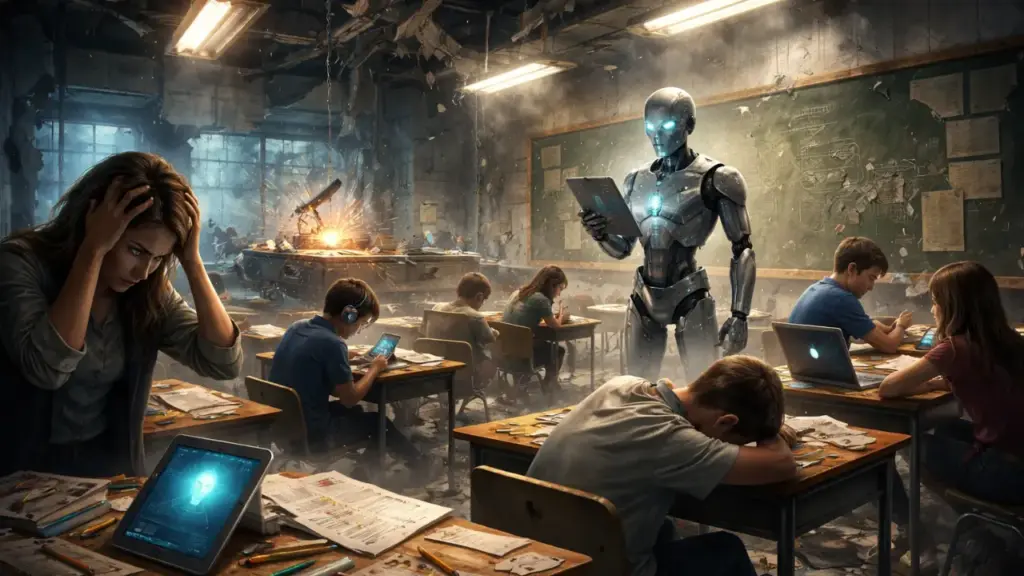
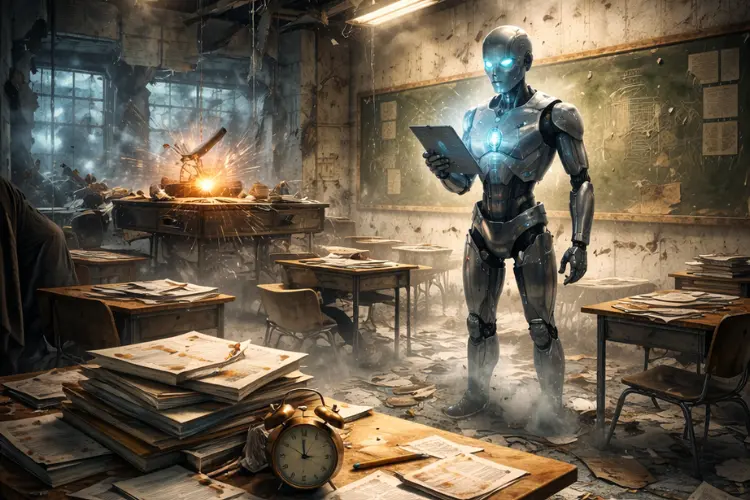
Educational institutions continue to frame AI as a threat to integrity. Many schools prohibit its use and label it as academic dishonesty. Meanwhile, the job market operates on the opposite assumption. Companies expect employees to use AI tools for speed, accuracy, and scale. Graduates trained to avoid AI enter workplaces where AI literacy is mandatory. This hypocrisy leaves students unprepared and disadvantaged. Education punishes the very behavior that industry rewards. The longer this contradiction persists, the deeper the damage becomes.
Academia vs Reality: A System That Cannot Move Fast Enough
Universities operate on slow cycles. Curriculum updates take years. Approval processes move cautiously. AI evolves in months. By the time a course launches, the tools it teaches may already be obsolete. This is not a failure of educators. It is a limitation of the system itself. Academia prioritizes theory, structure, and credentials. The market prioritizes execution, speed, and outcomes. As this gap widens, degrees drift further away from real-world relevance.
The Human Cost: Students Trapped in the Middle
Students trusted the system. They followed instructions and absorbed debt in exchange for promised opportunity. Now many graduate into uncertainty, rejection, and underemployment. The psychological impact is severe. Anxiety rises as expectations collapse. Confidence erodes when effort does not translate into results. This experience leaves many graduates questioning their worth rather than questioning the system that failed them. Hard work still matters, but it no longer guarantees stability. That realization hits hardest after graduation.
What This Means for Students Right Now
Students can no longer rely on institutions to define readiness. Skill acquisition must become continuous and self-directed. AI literacy is no longer optional. It is foundational. Students who learn how to collaborate with AI gain leverage that degrees alone cannot provide. Portfolios, real projects, and visible outcomes matter more than transcripts. College can still add value, but only when combined with practical execution. Adaptability is now the most important skill a graduate can possess.
What This Means for Employers
Employers must rethink hiring assumptions. Degrees no longer predict productivity. Potential matters more than pedigree. Many modern startups now prefer lean teams supported by automation rather than large junior workforces. Some choose to work with a fractional CTO instead of building traditional entry-level engineering teams. This approach emphasizes expertise, speed, and efficiency. It reflects how AI reshapes organizational structure. Companies that adjust hiring strategies early gain a competitive advantage in a rapidly changing market.
Why the Education System Faces an Existential Crisis
This disruption is not temporary. AI will continue advancing, and markets will continue optimizing. Education systems must redefine their purpose or risk irrelevance. Teaching memorization no longer works. Teaching how to learn, adapt, and apply tools does. Institutions must embrace AI instead of resisting it. They must align with how work actually happens. History shows that systems unwilling to evolve eventually collapse. Education now stands at that threshold.
FAQS
Is college still worth it?
Yes, but only if combined with real-world skills, AI literacy, and continuous learning.
Is AI replacing all jobs?
No. AI replaces tasks, not ambition. It rewards those who use it effectively.
Should students avoid college?
No. Students should avoid relying on college alone.
What skills matter most today?
AI usage, problem-solving, communication, adaptability, and proof of work.
Conclusion: A System at a Crossroads
Education is not broken beyond repair, but it is undeniably outdated. AI did not destroy opportunity. It revealed long-standing weaknesses. Students must stop waiting for permission to learn. Employers must stop relying on outdated hiring filters. Institutions must confront reality instead of defending tradition. The future belongs to those who adapt early and learn continuously. Honest conversations about careers, AI, and the real job market are essential, which is why platforms like StartupHakk exist. The system is changing whether we like it or not. The only real choice left is how fast we respond.