
The Leaked Messages That Changed Everything
The lawsuits against OpenAI existed before the Slack messages became public. However, those messages shifted the legal narrative dramatically. Courts ordered OpenAI to preserve internal communications after suspecting that critical evidence could disappear. Once disclosed, those conversations allegedly showed employees discussing the removal of datasets and traces of how the data was sourced.
In copyright law, intent matters. Knowledge matters even more. Actions taken after a dispute begins matter most of all. If a court determines that OpenAI knowingly used pirated content and then attempted to erase evidence, the case moves from a debate over fair use to one of willful infringement. That distinction carries far harsher penalties. These messages now form the backbone of multiple lawsuits and may heavily influence how judges interpret OpenAI’s actions.
The Core Allegation: Training on Pirated Data
At the center of every lawsuit lies one fundamental question: where did the training data come from? Large language models require massive volumes of text to function effectively. Books provide rich, structured language that is difficult to replace. Plaintiffs argue that OpenAI ingested copyrighted books without permission, licensing agreements, or compensation.
The scale of the alleged infringement magnifies the risk. This is not about a small sample of texts or limited datasets. The claims involve millions of books. Copyright law treats each work individually. That means every unauthorized book can represent a separate violation. When multiplied at this scale, even conservative legal interpretations create staggering exposure.
The Lawsuits Piling Up Against OpenAI
OpenAI is not defending against a single isolated case. It faces multiple lawsuits from different sectors, each attacking a different dimension of the same issue. The New York Times lawsuit focuses on direct competition, arguing that AI systems reproduce journalism in ways that undermine its business model. Authors’ class-action suits emphasize economic harm and lost income. Hollywood agencies frame the issue as systemic theft that threatens creative industries.
Each case follows a different legal strategy, but all rely on the claim that OpenAI trained its models on copyrighted material without authorization. Even if OpenAI succeeds in defending one case, others remain. The cumulative pressure makes this legal situation uniquely dangerous.
Why the Anthropic Settlement Changed the Stakes
For a long time, AI companies downplayed copyright lawsuits as manageable risks. That perception changed when Anthropic settled a similar case for a reported $1.5 billion. The settlement included no admission of wrongdoing, but it set a powerful precedent. It demonstrated that courts and plaintiffs are willing to demand massive payouts.
OpenAI’s exposure may be significantly larger. Its models are more widely deployed, its datasets are broader, and its commercial reach is deeper. Legal analysts suggest that OpenAI’s potential liability could be many times higher than Anthropic’s. Once a benchmark exists, courts use it to anchor expectations. That is why this settlement reshaped the entire legal landscape for AI companies.
The Terrifying Math of Statutory Damages
Copyright law allows courts to award statutory damages of up to $150,000 per infringed work when willful infringement is proven. Courts do not need to prove actual financial loss for each work. They only need to establish unauthorized use. Even if judges award a small fraction of the maximum penalty, the numbers escalate quickly at scale.
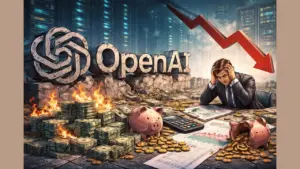
When millions of works enter the equation, the financial risk becomes existential. No level of venture funding or revenue growth can easily absorb damages of that magnitude. This is why investors are nervous, partners are cautious, and silence from OpenAI’s leadership is increasingly noticeable.
Could This Actually Destroy OpenAI?
The idea of OpenAI failing may seem unrealistic, but history shows that even dominant technology companies can collapse under legal pressure. OpenAI already operates with enormous costs. AI infrastructure requires continuous investment in compute, energy, and talent. At the same time, competition is increasing and margins are tightening.
Large legal penalties would reduce cash reserves, weaken investor confidence, and distract leadership. Enterprise customers demand compliance and predictability. Governments demand accountability. If trust erodes, partnerships dissolve quickly. Innovation alone cannot protect a company from sustained legal and reputational damage.
The Role of Leadership and Governance
Crises test leadership more than success ever does. Strong leadership emphasizes transparency, compliance, and accountability. Weak leadership prioritizes damage control and denial. Governance failures often begin with technical shortcuts taken in the name of speed.
Many growing companies now rely on a fractional CTO to manage architectural decisions, data governance, and regulatory risk. This role helps balance innovation with responsibility. Early-stage AI companies often ignored this discipline. Speed replaced caution. Growth replaced governance. The consequences of those choices are now becoming clear.
The Bigger Picture: AI’s Copyright Reckoning Has Begun
This legal battle is not just about OpenAI. It signals a broader shift across the AI industry. Most large models trained on scraped data face similar scrutiny. Courts are now defining the boundaries of acceptable AI development.
The era of unchecked data scraping is ending. The future of AI will involve licensing, documentation, and traceability. Models will cost more to build. Development cycles will slow. Legal teams will work alongside engineers. This transition may reduce short-term innovation, but it creates long-term stability and trust.
What This Means for Businesses and Developers
Businesses using AI must understand the risks involved. Generated content can carry legal exposure if training data is challenged. Data provenance matters more than ever. Developers must document sources and respect licensing terms. Enterprises should audit AI vendors and demand transparency.
Ignoring these realities invites future disputes. Responsible AI adoption requires governance, not blind enthusiasm.

Conclusion: AI Can’t Ignore the Law Forever
AI will continue to evolve, but reckless AI will not survive. The lawsuits against OpenAI represent a defining moment for the industry. Scale no longer excuses shortcuts. Innovation no longer shields companies from accountability. Copyright law moves slowly, but it enforces consequences relentlessly.
Whether OpenAI survives depends on decisions still unfolding in courtrooms. What is already clear is that AI has entered its accountability era. Growth must align with legality. Speed must respect ownership. This moment will shape the next decade of artificial intelligence, and platforms like startuphakk exist to document and analyze these critical turning points.