
The Timeline Problem — AI Isn’t There Yet
The biggest flaw in the AI job-loss argument is timing. Every credible study places large-scale displacement in 2030 or later, including reports from McKinsey, the OECD, and the World Economic Forum. Current AI systems remain narrow in scope. They solve specific problems but do not think independently. General intelligence does not exist yet, autonomy is limited, and human oversight is still mandatory. If AI were truly replacing workers today, productivity numbers would show a clear spike—but they do not. Employment transitions take time, and technology adoption consistently moves slower than hype suggests. The timeline simply does not support the panic.
What AI Actually Can’t Do (Yet)
AI looks impressive in demos, but reality is far less glamorous. Today’s AI systems still struggle with consistency, often producing different results for the same task and failing in real-world scenarios where accuracy and reliability matter most.
They cannot:
- Write bug-free production code reliably
- Draft legally binding documents without review
- Handle complex edge cases without human input
- Understand business context the way people do
Ask any senior engineer, any lawyer, or any doctor, and you will hear the same answer. AI can speed up tasks, reduce manual effort, and improve efficiency, but it cannot replace human judgment. Complex decisions still require experience, context, and accountability. AI works best as a support tool, not as a substitute for professional expertise.
That is why companies still need:
- Engineers
- Legal professionals
- Product managers
- Fractional CTOs to guide AI strategy responsibly
Tools improve productivity.
They do not eliminate accountability.
Job Postings vs. Job Losses — A Crucial Distinction
Many people confuse job postings with actual job losses, but they are not the same. Companies are often rewriting job descriptions, adding terms like “AI-assisted” or “AI-enabled,” which creates the illusion that workers are being displaced. In reality, headcount remains stable in most sectors, with roles evolving and titles changing rather than being eliminated. This process is not about replacement; it is about repositioning. Some companies do this for optics, while others do it to signal innovation to investors. What appears as mass automation is often just a form of innovation signaling. True AI-driven layoffs are rare, and when they do occur, they are usually limited in scale.
History Repeats — Automation Never Moves in Quarters
We have seen this pattern before. The Industrial Revolution unfolded over decades, transforming industries and labor gradually rather than instantly. Similarly, the adoption of office computers took years to fully reshape workplaces, and the internet followed the same slow trajectory, changing how businesses operated over time. Cloud computing also required a gradual shift, with organizations adjusting processes and infrastructure step by step. Each of these technological waves sparked fear and uncertainty, yet none of them wiped out work overnight. AI is no different; its impact will be significant, but it will unfold gradually, giving workers and organizations time to adapt.
Large systems require:
- Infrastructure
- Training
- Integration
- Regulation
Those processes are slow, and expecting AI to replace millions of workers within just a few quarters completely ignores historical patterns. Technology adoption is gradual, often taking years or even decades to reach its full impact, while hype spreads almost instantly.
The “Slowly, Then Suddenly” Reality
Every major technological shift follows a predictable pattern. Initially, there is excitement as people imagine the possibilities. This is followed by a period of frustration when limitations become apparent and expectations exceed reality. Gradual progress then sets in as the technology matures and adoption spreads. Sudden, transformative change comes later, often after years of incremental improvements. After 25 years in the tech industry, this pattern is evident. AI, at present, is still in its early phase. While models continue to improve, costs remain high and reliability is inconsistent. We are firmly in the “slowly” stage of adoption, and it is inaccurate to claim that we have already entered the “suddenly” phase of rapid, disruptive change.
Capital Tells the Truth — And It’s Not Following AI Fear
Capital never lies. If AI were truly replacing workers today, companies would be investing aggressively, spending, and automating at scale. Instead, many organizations are hoarding cash, with corporate savings sitting at record levels. Capital expenditures (CapEx) are growing cautiously, and hiring freezes are often driven by financial considerations rather than AI performance. If AI genuinely functioned as a workforce replacement, CFOs would act decisively—but they are not. This stark contrast between the AI narrative and actual corporate behavior is highly revealing.
The Real Cause of Workforce Dropout
Labor force participation has declined, and AI is not the cause. Wages have failed to keep up with inflation, while housing and healthcare costs have surged. As a result, many people cannot afford to work at current wage levels. This is primarily an economic issue, not a technological one.
Blaming AI distracts from:
- Monetary policy errors
- Cost-of-living pressures
- Structural wage stagnation
Technology becomes a convenient excuse.
Why Blaming AI Is Convenient — And Dangerous
Future technology makes an easy scapegoat because it cannot respond, vote, or challenge policy decisions. Blaming AI shifts responsibility away from institutions, which is a dangerous practice. When problems are misdiagnosed, it leads to poor policies, and fear spreads faster than facts, causing unnecessary panic among workers. While AI deserves serious discussion and careful analysis, it does not deserve to be blamed for problems unrelated to its actual impact.
Where AI Is Actually Creating Jobs
AI is not destroying work.
It is reshaping it.
New roles are emerging:
- AI operations specialists
- Prompt engineers
- Data governance experts
- Ethical AI advisors
- Fractional CTOs helping startups adopt AI responsibly
Small companies benefit the most from AI because it lowers barriers to entry, allowing them to compete with larger organizations more effectively. By increasing leverage, AI enables lean teams to accomplish more with fewer resources, streamlining operations and boosting productivity. Rather than causing job loss, this shift represents job evolution, where roles transform and adapt to new technological capabilities.
What Workers Should Actually Prepare For
The future of work is not unemployment.
It is adaptation.
Workers who:
- Learn AI tools
- Combine domain knowledge with technology
- Focus on problem-solving
Those who adapt and embrace AI tools will remain valuable in the workforce. AI rewards skill stacking, allowing individuals to combine their expertise with technology to create greater impact. Conversely, stagnation is heavily penalized, as those who resist learning new tools risk falling behind. Fear is optional, but preparation is essential—investing time in upskilling and understanding AI now ensures long-term relevance and success.
Conclusion: AI Isn’t the Villain — Misdiagnosis Is
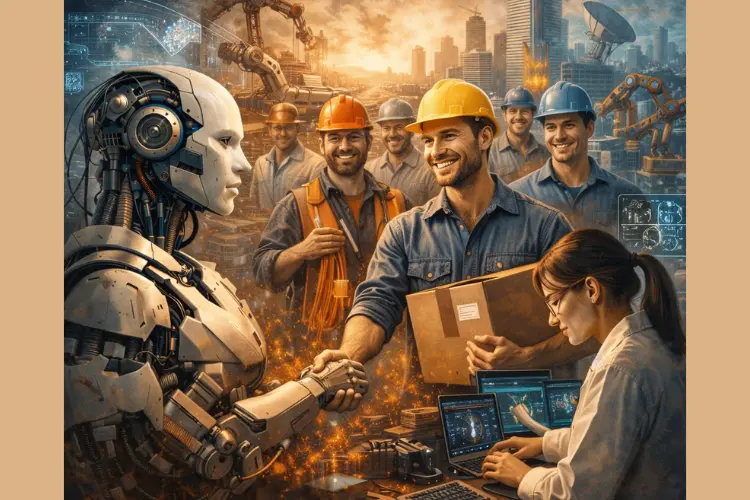
AI will change work, and that is inevitable. However, it will not collapse employment overnight, and it is not today’s problem. Blaming AI for current economic stress reflects either ignorance or intentional misdirection. The real risk lies in poor policy decisions driven by false narratives. What we need are facts, context, and honesty. This is precisely the kind of conversation that StartupHakk exists to promote—encouraging clear thinking in a noisy and often misleading tech world.