Nvidia’s Reign in the AI Chip Market
Nvidia did not dominate by accident. It earned its position over more than a decade by building GPUs that excelled at parallel processing, which made them ideal for AI training. However, hardware alone was not the real advantage. Nvidia introduced CUDA, a powerful software ecosystem that developers quickly adopted to build their tools. This created strong lock-in, as AI teams optimized their code specifically for Nvidia GPUs, making switching both expensive and risky. Cloud providers followed the same path, with AWS, Azure, and Google Cloud all offering Nvidia-based instances. Over time, startups and large enterprises standardized on Nvidia as the default choice. For many years, Nvidia had no real competitor operating at scale, but that era may now be coming to an end.
Meta’s $70+ Billion AI Infrastructure Gamble
Meta’s AI ambitions are enormous. The company aims to power social platforms, advertising systems, AI assistants, and future metaverse products at a global scale. This vision demands massive computing power. To support it, Meta plans to spend over $70 billion on AI infrastructure next year. At that level of investment, relying on a single hardware vendor becomes risky. Supply shortages can slow innovation, and pricing power can shift away from the buyer. Meta understands this challenge well. By exploring Google’s AI chips, the company gains leverage and greater flexibility. This decision is strategic, not emotional. Meta wants multiple options, and Google is now offering a viable alternative.
Anthropic’s Million-Chip Bet on Google TPUs
Anthropic’s decision sent shockwaves across the AI industry when the company committed to using one million Google TPUs. This move was not a marketing stunt or a short-term experiment. It was a long-term infrastructure decision built around scale, stability, and performance. Training frontier AI models requires predictable and massive compute capacity, and TPUs provide deep integration with Google’s data centers to meet that demand. By optimizing its models specifically for TPUs, Anthropic significantly reduced the cost per training run while improving overall efficiency. This decision highlights a critical shift in the market. Advanced AI labs are now willing to move away from Nvidia when the underlying economics and scalability make more sense.
Google’s Ironwood TPU: The Real Game Changer
Google’s Ironwood TPU is not just faster; it is architecturally different. It can connect 9,216 chips in a single pod, enabling massive parallelism at a scale rarely seen in AI infrastructure. In comparison, Nvidia’s Blackwell supports 72 chips per system, which is powerful but far smaller in scope. Large AI models benefit greatly from tight interconnects because data moves faster between chips, making training more efficient and reducing bottlenecks. Google designed Ironwood primarily for its own workloads, including Search, Gemini, and other internal AI systems, which directly shaped its architecture. Now, by offering that same power to external customers, Google is reshaping the competitive landscape of the AI chip market.
TPU vs GPU: Architecture Differences That Matter
GPUs are general-purpose accelerators designed to handle a wide range of tasks, including graphics rendering, artificial intelligence workloads, and high-performance computing. In contrast, TPUs are custom-built specifically for machine learning, which allows them to focus entirely on AI training and inference. This specialization gives TPUs a clear advantage in efficiency, as they deliver more performance per watt and significantly reduce training costs at large scale. GPUs still lead in flexibility because they support a broader range of frameworks and use cases across different industries. However, large AI labs prioritize scale and cost over versatility, and this is where TPUs truly stand out. For organizations training massive AI models, architectural efficiency now matters more than brand loyalty.
Why Big Tech Is Designing Its Own Chips
Cost control drives this trend across the tech industry. At hyperscale, even small efficiency gains translate into billions of dollars in savings. Custom chips allow deep optimization, enabling workloads to run faster while wasting less power and compute. This efficiency becomes critical as AI models grow larger and more expensive to train.
There is also a strong strategic motivation behind this shift. Big Tech companies want independence from single vendors. Relying heavily on Nvidia gives it significant pricing power, while custom silicon shifts that balance back to the buyer. This move closely mirrors Apple’s transition away from Intel, where greater control delivered better performance and long-term leverage.
Even startups are feeling the impact of this change. Many now consult a fractional CTO early to evaluate infrastructure choices before scaling. Smart hardware decisions made at the beginning can define cost efficiency, flexibility, and long-term scalability as the business grows.
Is Nvidia Actually in Trouble?
Nvidia is not collapsing. It still dominates the broader AI ecosystem, and CUDA remains deeply entrenched, with most developers continuing to target Nvidia first. The company also moves fast, and its Blackwell architecture represents a major leap forward. However, Nvidia no longer owns the entire market, as large buyers are beginning to diversify their options. This is not a fall, but rather a shift from monopoly-like dominance to a more competitive landscape. This change is significant and will shape the future of AI hardware.
The Future of AI Chips: One Winner or Many?
The AI hardware market is fragmenting as different workloads demand different solutions. Cloud providers are increasingly pushing custom chips, while many enterprises may continue to rely on Nvidia. Startups, on the other hand, are likely to choose based on cost and access, prioritizing flexibility over loyalty. As a result, there may never be a single dominant winner again. Instead, multiple ecosystems will coexist, and this competition will drive faster innovation, ultimately benefiting everyone.

Conclusion: The AI Chip Throne Is No Longer Safe
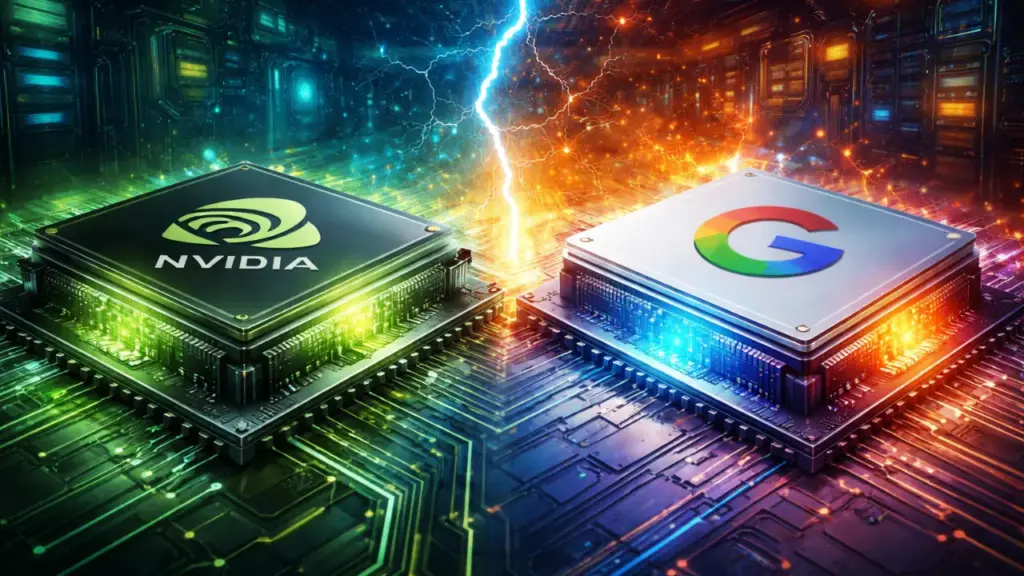
Nvidia still leads the AI chip world, but its throne is no longer untouchable. Google’s TPUs have emerged as serious contenders, and moves by Meta and Anthropic show that the shift is already underway. This isn’t the downfall of Nvidia—it marks the end of uncontested dominance. For founders, developers, and decision-makers, understanding these changes is crucial, as infrastructure choices have become a strategic advantage. Insights like these are exactly why platforms such as StartupHakk exist: to help builders stay ahead of real industry shifts rather than following hype. The AI chip war has begun, and this time, the king faces real competition.