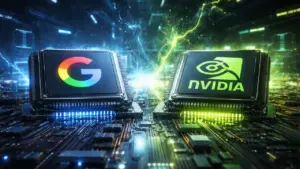

The $70 Billion Question: Why Meta Is Shopping Around
Meta plans to spend between seventy and seventy-two billion dollars on AI infrastructure next year. At that scale, efficiency becomes critical. Every percentage point in cost and performance has long-term consequences. Nvidia GPUs deliver power, but they also bring high prices and vendor lock-in. Meta wants leverage and independence. It wants infrastructure optimized for its own models and workloads. This is not a rejection of Nvidia’s technology. It is a strategic move to reduce dependency. At hyperscale, relying on a single vendor is no longer safe.
Anthropic’s Million-Chip Bet on Google
Meta is not the only company rethinking its hardware strategy. Anthropic recently committed to using one million Google TPUs. This was not a test deployment or a short-term experiment. It was a long-term infrastructure decision. Anthropic trains some of the most advanced AI models in the world. Its workloads are massive and unforgiving. The company chose Google TPUs because they scale efficiently and integrate deeply with Google’s AI ecosystem. This decision signals growing trust in custom silicon built specifically for AI.
TPU vs GPU: Why Architecture Matters More Than Hype
GPUs were originally designed for graphics processing. Their flexibility later made them suitable for AI workloads. TPUs follow a different philosophy. Google designed them exclusively for machine learning. Every component in a TPU serves a specific purpose. Nothing is generalized. This focus allows TPUs to deliver higher efficiency for training and inference at scale. GPUs remain versatile and powerful, but as models grow larger, architectural efficiency becomes more important than raw compute. Purpose-built hardware starts to outperform general solutions.
Ironwood vs Blackwell: The Scale Problem
Google’s latest TPU system, known as Ironwood, can connect 9,216 chips in a single pod. Nvidia’s Blackwell architecture connects seventy-two chips per system. This gap is not incremental. It is structural. Ironwood behaves like one massive computer, while Blackwell operates as many smaller units. Large AI training jobs require constant synchronization across chips. Communication speed becomes critical. When systems scale poorly, latency increases and performance drops. Google addressed this challenge at the system level, not just the chip level.
128x More Connected Compute: Why This Changes AI Economics
Ironwood enables 128 times more connected compute than Blackwell in a single system. This level of connectivity changes the economics of AI training. Large models constantly exchange data between chips. Faster communication reduces idle time. Reduced idle time lowers energy consumption. Lower energy consumption cuts cost. These gains compound at scale. This is why hyperscalers focus on architecture rather than benchmarks. Efficient systems make advanced AI financially sustainable.
Why Nvidia Is Still Dominant (For Now)
Nvidia remains the market leader, and that position is not disappearing overnight. Its CUDA ecosystem is deeply embedded across the industry. Developers are trained on it. Enterprises trust it. Migration costs are high, and switching infrastructure takes time. Nvidia also continues to innovate aggressively. Blackwell itself is a major technical achievement. However, dominance no longer means immunity. The ecosystem moat is still strong, but it is no longer unchallenged.
The Real Shift: From General GPUs to Purpose-Built AI Silicon
The bigger story goes beyond Nvidia and Google. The entire industry is shifting toward purpose-built AI silicon. Google has TPUs. Amazon has Trainium and Inferentia. Meta is designing its own chips. These companies want control over cost, performance, and long-term strategy. Hardware decisions now shape competitive advantage. Many organizations bring in a fractional CTO to guide these choices because AI infrastructure errors can cost billions. Hardware is no longer a backend concern. It is a strategic pillar.
Who Wins This AI Chip War?
There will not be a single winner. Nvidia will remain essential for startups, researchers, and enterprises that value flexibility. Google will dominate its internal workloads and partners that benefit from extreme scale. The market will fragment, and that fragmentation is healthy. Competition accelerates innovation. The AI chip war is not about replacing Nvidia. It is about creating alternatives that balance power across the ecosystem.
What This Means for Startups and Investors
Startups should evaluate their workloads instead of blindly following industry defaults. Training, fine-tuning, and inference all have different infrastructure needs. Investors should pay close attention to infrastructure spending decisions because they reveal long-term strategic direction. AI success depends on system-level thinking. Models alone are not enough. Hardware choices increasingly determine who can scale sustainably.

Conclusion: Nvidia Isn’t Dead — But the Crown Is Slipping
Nvidia did not fail. The market evolved. Google did not win overnight. It planned patiently. AI infrastructure is entering a new phase where specialization beats generalization and control outweighs convenience. The future belongs to companies that design entire systems instead of relying on off-the-shelf solutions. This shift matters to founders, investors, and technologists, and it reflects the deeper trends we analyze at startuphakk. The AI race is no longer just about speed. It is about architecture, ownership, and long-term vision.