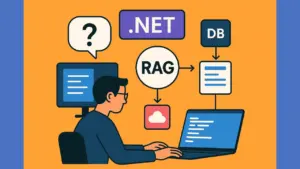

What Most Developers Get Wrong About RAG
Most RAG tutorials teach theory, not reality. They introduce RAG like a PhD project. They use heavy ML libraries that fail in production for small teams. They teach you systems that cost more to host than the value they create.
Here are the most common mistakes developers make:
1. Overengineering the Architecture
Many teams jump straight to Pinecone, Milvus, Chroma, Qdrant, or other vector-heavy tools. These are fantastic tools—but they’re unnecessary for most cases. You don’t need a rocket engine to drive to the grocery store.
2. Confusing RAG With Machine Learning
RAG is not ML. RAG is a pattern. A retrieval pattern plus a generation model. You can build it with basic search logic and an LLM API.
3. Thinking They Need Expensive Infrastructure
Developers believe they must embed millions of tokens or store everything in GPU-powered clusters. Most businesses don’t need that. A small SQL database and simple similarity scoring are enough.
4. Forgetting the Business Goal
The purpose of RAG is not technical perfection.
It’s solving real business problems:
- Support automation
- Knowledge retrieval
- Policy search
- Technical content summarization
- Compliance workflows
When you focus on outcomes, the architecture becomes simpler.
The Practical Approach: What You Actually Need
You don’t need complex math to build a working RAG system. You only need three components:
1. Storage
This could be:
- SQL Server
- Postgres
- SQLite
- JSON files
- Even a text file directory
You only need a place to store documents or chunks.
2. Retrieval Logic
This can be:
- Keyword matching
- BM25
- Cosine similarity
- Semantic keywords
You don’t need a vector database. You need a reliable way to pull the top-matching chunks.
3. Generation
Any LLM can work:
- OpenAI
- Azure OpenAI
- Ollama
- HuggingFace models
- Any local LLM
The LLM generates the final answer using the retrieved context.
That’s it. That’s the entire RAG workflow. Nothing more.
The .NET-Friendly RAG Architecture
.NET developers don’t need to switch languages or frameworks. You can build a clean and efficient RAG pipeline using the ecosystem you already know.
High-Level Architecture
-
Data Preparation
Convert your documents into chunks. Save metadata and chunk text in a simple database table.
-
Query Handling
Take user input. Pre-process it.
-
Retrieval
Search for the most relevant chunks. Use basic ranking.
-
Prompt Building
Embed retrieved text into an LLM prompt.
-
Generation
Call your chosen LLM API.
-
Response Output
Send the generated answer back to the user.
This flow is easy, cheap, and stable.
Why .NET Makes RAG Easy
- Strong libraries
- Stable performance
- Clean async APIs
- Easy integration with OpenAI or Azure OpenAI
- Familiar to enterprise teams
Most companies already trust .NET for production systems. Adding RAG on top is natural.
Step-By-Step Implementation
5.1. Preparing Your Data
Start by placing all your documents in a folder. Each document might be:
- PDF
- Word file
- Markdown
- HTML
- Plain text
Step 1: Extract text
Step 2: Split into chunks (e.g., 300–500 characters each)
Step 3: Save chunks into a SQL table:
Id | DocumentName | ChunkText | Keywords | CreatedAt
You can auto-generate keywords using simple keyword extraction. No embeddings needed.
5.2. Simple Matching in .NET
You only need a function that returns relevant chunks.
You can apply:
- Keyword overlap
- BM25 via a NuGet package
- Cosine similarity on TF-IDF vectors
This is enough for 80% of business problems.
You can write a simple query:
SELECT TOP 5 ChunkText
FROM Chunks
WHERE ChunkText LIKE ‘%’ + @Query + ‘%’
For richer results, combine BM25 ranking. It takes minutes to integrate.
5.3. Passing Retrieved Chunks to the LLM
Once you extract the 3–5 best chunks, combine them into a structured prompt:
You are a helpful assistant. Use only the provided context.
Context:
[chunk1]
[chunk2]
[chunk3]
Question:
{user_question}
Answer using clear and short sentences.
This prevents hallucinations and keeps the system stable.
5.4. Testing the Full Flow
Try sending a real question like:
“What is our refund policy for international clients?”
The pipeline will:
- Search relevant chunks
- Pull the refund policy text
- Pass it to the LLM
- Produce an accurate answer
This is real, practical RAG.
Real Business Use Cases You Can Deploy Tomorrow
1. Customer Support Agents
Build a support bot that knows your FAQs, policies, and workflows. Your support team will save hours every week.
2. Internal Knowledge Bases
Employees can ask questions like:
- “How do we configure SSL for client X?”
- “Where is the deployment checklist?”
The RAG engine finds the answers.
3. Technical Documentation Assistants
Developers can search coding rules, DevOps steps, or architecture notes. RAG delivers fast and accurate results.
4. Policy and Compliance Lookup
Legal teams often search through long documents. RAG simplifies that instantly.
5. Data-Driven Enterprise Workflows
RAG can help finance teams, HR teams, and product teams fetch information from complex documents.
These use cases don’t require expensive infrastructure. Just practical engineering.
Cost Comparison: Fancy RAG vs Practical RAG
Traditional Overengineered RAG
- Vector DB subscription: high
- GPU hosting: expensive
- Embedding generation: costly
- Complex infrastructure: time-consuming
Practical .NET RAG
- Use SQL or SQLite: free
- Simple search: free
- LLM usage only when needed
- Easy scaling through standard .NET deployment
Your cost stays low and predictable.
If you’re working with a small team or building an early MVP as a fractional CTO, this lightweight RAG approach gives you speed, stability, and full control.
Common Mistakes to Avoid
1. Over-Chunking the Data
If chunks are too small, context becomes useless. Keep chunks meaningful.
2. Passing Too Much Data to the LLM
More data ≠ better answers. It increases cost and reduces accuracy.
3. Ignoring Real User Queries
Test with real-language questions from actual users.
4. Forgetting Rate Limits
LLM APIs have limits. Always handle retries and errors.
5. Not Logging Retrieval Quality
You must measure which chunks were retrieved, their ranking score, and user satisfaction.
Good engineering beats hype every time.
Final Working RAG Template for .NET Developers
Step 1: Store documents
Use SQL or files.
Step 2: Chunk data
Split into readable sections.
Step 3: Rank documents
Use simple keyword or semantic scoring.
Step 4: Build structured prompts
Combine top results into one context prompt.
Step 5: Call the LLM API
Use .NET’s clean HttpClient with async.
Step 6: Deploy
Host on Azure, AWS, on-prem, or Docker.
With this workflow, you get a RAG system that works in real business environments.
Conclusion
RAG doesn’t need to be complex. You don’t need massive ML pipelines or expensive vector engines to deliver intelligent applications. With .NET, simple retrieval logic, and clean prompt design, you can build a powerful and reliable RAG system that solves real business problems.
As a fractional CTO, I’ve seen that teams who focus on practicality deliver better results, faster products, and lower costs. You can implement everything in this guide and deploy a working solution within a day. And if you want more deep technical insights, you’ll find even more practical engineering content at startuphakk.