
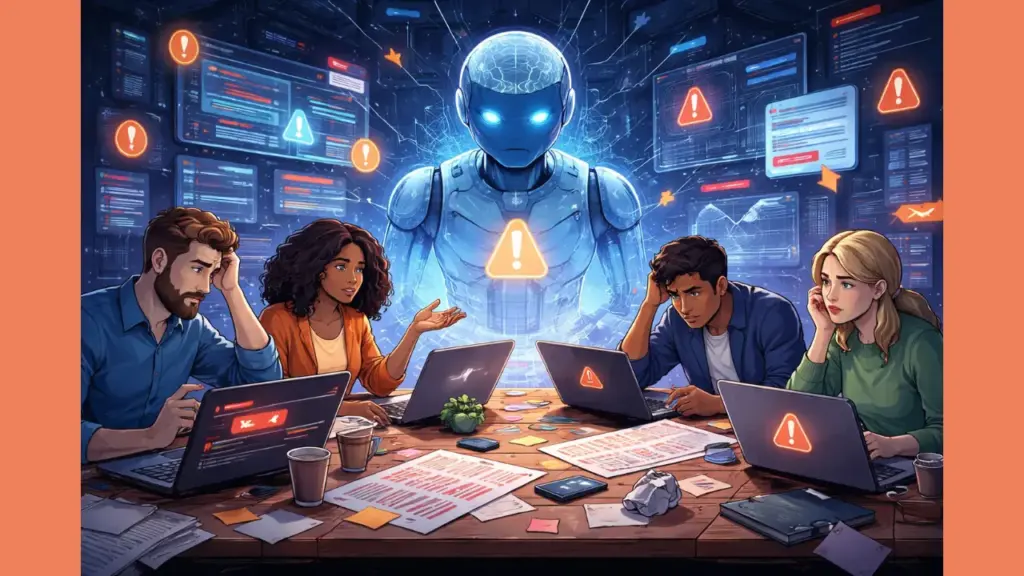
AI Is Not Intelligence—It Is Pattern Matching
AI does not think or reason. It predicts. Large language models generate responses by calculating probabilities based on training data. They do not understand meaning or intent. They recognize patterns and reproduce them convincingly. This creates an illusion of intelligence. That illusion becomes dangerous when teams trust AI output without verification. Confident answers hide incorrect assumptions. When leaders mistake prediction for understanding, systems fail in subtle but costly ways.
AI Is Still Just Software
AI runs on code like every other system. It depends on infrastructure, inputs, outputs, and maintenance. It contains bugs. It breaks under edge cases. It degrades over time. AI does not escape engineering discipline. It requires testing, monitoring, logging, and rollback plans. Treating AI as special software leads teams to skip fundamentals. Those shortcuts always surface later as production failures.
Simple Scripts Still Beat AI in Many Use Cases
Not every problem needs artificial intelligence. Many never will. Automation existed long before the AI boom. Scheduled jobs, rule engines, and shell scripts remain faster, cheaper, and more reliable for deterministic tasks. Using AI where logic is clear adds cost without value. Smart teams ask a basic question before adding AI. Can simple code solve this problem? If the answer is yes, AI becomes technical debt instead of innovation.
AI Infrastructure Is Expensive and Persistent
AI costs do not end after launch. They scale with usage and ambition. Training models consumes compute. Inference costs grow quietly as traffic increases. Cloud bills rarely shrink. Executives see impressive demos, but engineers see long-term expenses. Without careful planning, AI becomes a permanent financial burden. This is where experienced technical leadership matters. A fractional CTO often helps companies avoid expensive architectural mistakes before they become irreversible.
AI Does Not Understand Your Business Context
AI lacks institutional memory. It does not know why certain rules exist. It does not understand historical decisions or regulatory constraints. Your business logic evolved through real-world failures and lessons. AI only sees surface-level patterns. This gap causes errors that appear correct at first glance. Those errors often emerge months later, when fixing them costs far more than building correctly from the start.
AI Fails Silently and Confidently
Traditional software crashes when something goes wrong. AI often does not. It produces fluent responses that appear correct even when they are wrong. These hallucinations make AI risky in production environments. Confident mistakes erode trust faster than visible failures. Teams must assume AI will fail and design systems accordingly. Ignoring this reality creates ethical and operational risks that no organization should accept.
Training Data Is a Liability, Not a Superpower
Data quality determines AI quality. More data does not guarantee better results. Training data contains bias, outdated assumptions, and legal risk. Poor data scales poor decisions. Teams that treat data casually inherit invisible problems. These problems eventually surface in public and damage credibility. Responsible AI requires strict data governance, not blind optimism.
AI Increases System Complexity
AI does not simplify software systems. It adds layers. Teams introduce model dependencies, prompt logic, evaluation pipelines, and monitoring overhead. Debugging becomes probabilistic. Reproducing failures becomes difficult. Complexity reduces development speed and increases operational risk. Only teams with strong engineering discipline can manage this complexity effectively.
Engineers Still Do the Real Work
AI does not design system architecture. It does not make trade-offs. It does not take responsibility for failures. Engineers still make decisions. Engineers still debug systems. Engineers still own outcomes. The belief that AI replaces engineers misunderstands both technology and software development. In reality, experienced engineers become more valuable as systems grow more complex.
The Boardroom and the Codebase Are Disconnected
Executives consume AI narratives shaped by marketing and investor pressure. Engineers experience AI limitations firsthand. This disconnect creates tension inside organizations. Roadmaps drift. Expectations break. Delivery slows. When leadership ignores engineering feedback, products suffer. Companies that succeed close this gap early. They listen to builders. They reward realism. A fractional CTO often helps translate business ambition into technical reality.
Where AI Actually Creates Real Value
AI delivers value when used narrowly and intentionally. It performs best as an assistant, not an autonomous decision-maker. AI improves productivity when it supports humans rather than replaces them. Teams that understand this boundary see real gains. Teams that ignore it chase illusions.
How to Use AI Without Destroying Your Product
Successful teams treat AI like any other dependency. They define limits. They measure outcomes. They monitor behavior. They budget conservatively. They start small and expand only when value is proven. Engineering discipline always comes first. Hype never replaces fundamentals.

FAQS
Is AI just software?
Yes. AI is software built on models, data, and infrastructure.
Does AI replace software engineers?
No. AI increases the importance of experienced engineers.
Why do AI projects fail?
Poor expectations, bad data, high costs, and lack of engineering discipline.
When should companies use AI?
When problems are probabilistic, narrow, and benefit from pattern recognition.
Conclusion: Stop Worshipping AI—Start Engineering It
AI is not magic. It never was. The companies that succeed will not be the loudest advocates. They will be the most disciplined builders. They will treat AI as a tool, not a belief system. They will rely on engineering judgment instead of hype-driven fear. Whether you are a founder, an executive, or serving as a fractional CTO, the lesson remains clear. Reality always wins. This grounded, experience-driven perspective is exactly what we continue to explore at StartupHakk, where understanding limits matters more than chasing illusions.